
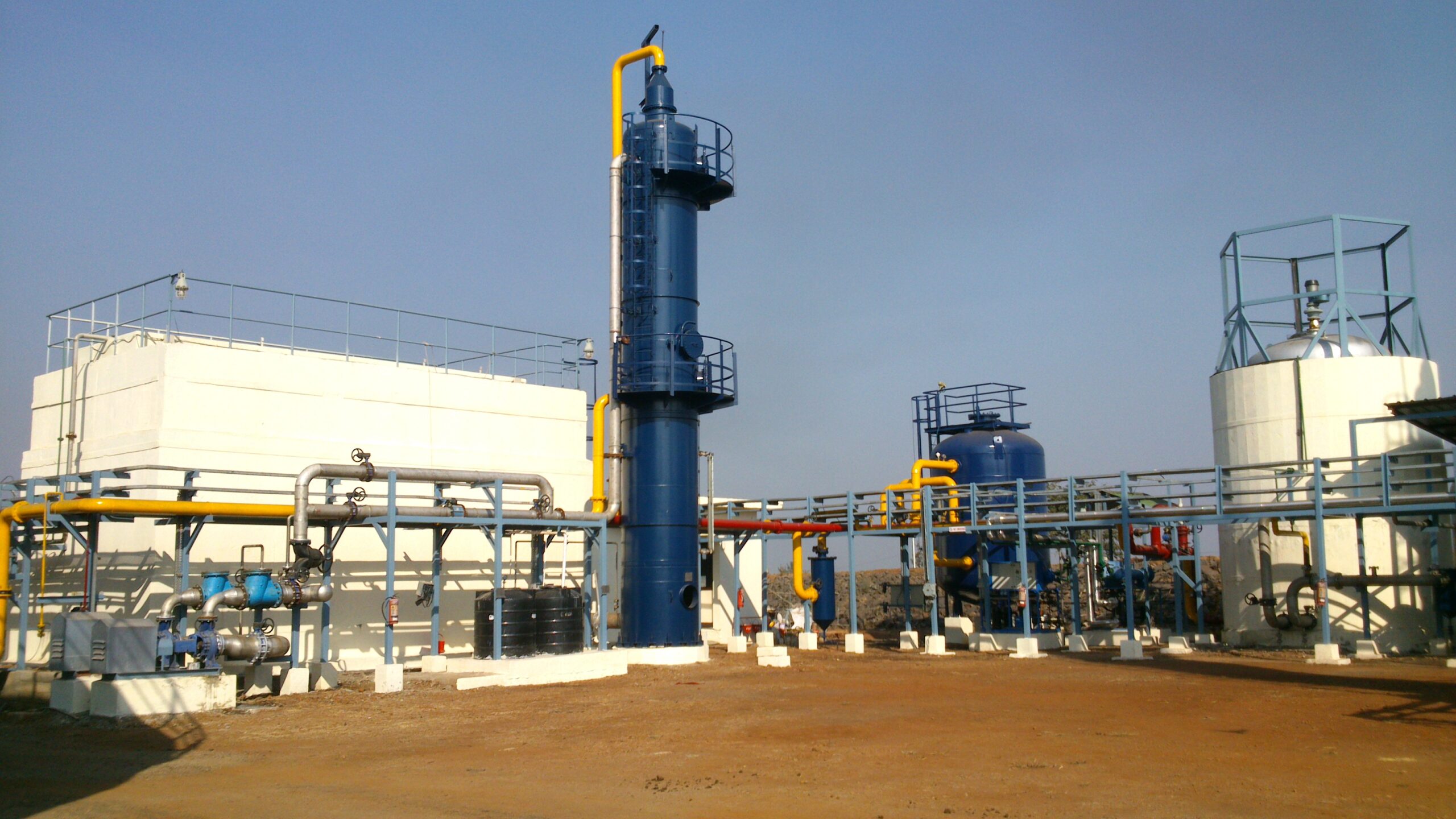
H2S Removal

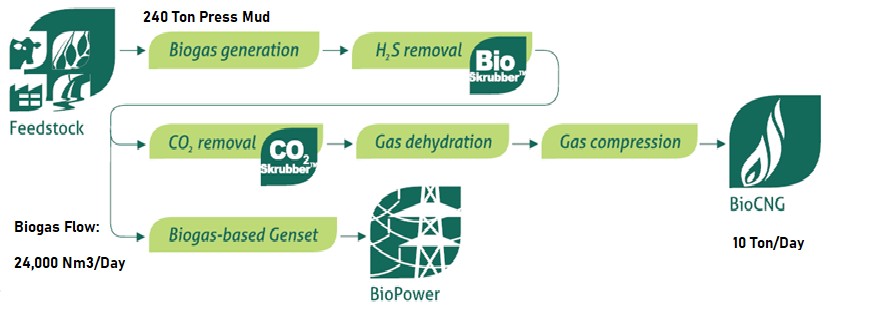
The project consists of Biogas Generation from organic material such as Press Mud and biogas cleaning for producing BioCNG.

The Biogas Cleaning to BioCNG plant consists of BioSkrubberTM system designed to reduce the H2S less than 20 ppm, and CO2 System, to remove the CO2 up to less than 3 % and moisture level to less than 5 mg/m3 in clean biogas.
ANEROBIC DIGESTER (UASB Digester)

Upflow anaerobic sludge blanket (UASB) technology, normally referred to as UASB reactor, is a form of anaerobic digester that is used for wastewater treatment. The UASB reactor is a methanogenic (methane-producing) digester that evolved from the anaerobic digester.

For UASB digester Waste water from CPU and Cow farm area along with centrate water is stored in buffer tank and then pumped to UASB reactor.

UASB uses an anaerobic process whilst forming a blanket of granular sludge which suspends in the tank. Wastewater flows upwards through the blanket and is processed (degraded) by the anaerobic microorganisms. The upward flow combined with the settling action of gravity suspends the blanket with the aid of flocculants. The blanket begins to reach maturity at around three months. Small sludge granules begin to form whose surface area is covered in aggregations of bacteria. The average retention time in the digesters is about 24 hours.

Biogas with a high concentration of methane is produced as a by-product. Biogas blower shall be provided to boost the biogas to secondary digester cum holder of CSTR or biogas will be directly flared.

H2S Scrubber System (BioSkrubberTM system)

The BioSkrubberTM system is an environmentally friendly biological process for H2S removal and recovery as H2S rich byproduct from Biogas streams. The most unique aspect of the process is that it utilizes a living biocatalyst to oxidize H2S to elemental sulphur. The biocatalyst belongs to the group of naturally occurring colourless sulphur oxidizing organisms known as Thiobacillus. These are autotrophic organisms, which mean that CO2 is required as their sole carbon source. The Thiobacillus catalyst is fast growing and highly resistant to varying process conditions. The energy needed for growth is obtained from the sulphide oxidation process. These organisms are naturally occurring and are neither genetically manipulated nor modified.

The BioSkrubberTM system has the following performance features:

  • No Hazardous waste
  • Less weight & space
  • Achieves essentially complete H2S removal and recovery.
  • Simple process configuration and control with stable operation.
  • Low operating and chemical costs.
  • Wide and flexible operating range with short system start-up and shut down times.
  • Environmentally friendly process based on a naturally occurring Thiobacillus biocatalyst.
  • Recovered H2S rich by-product (sulphur slurry) is hydrophilic and directly usable for fertilizer/agriculture applications.
  • Inherently safe operation

The BioSkrubberTM system process can be applied to sour feed gases with H2S concentrations ranging from 50 ppmv to 100 vol %. Regeneration of the scrubbing solution, rather than its disposal, is a key feature of the BioSkrubberTM system. Regeneration of the scrubbing solution is possible because the caustic consumption due to the absorption of H2S is compensated by the oxidation of H2S to sulphur slurry and hydroxide.

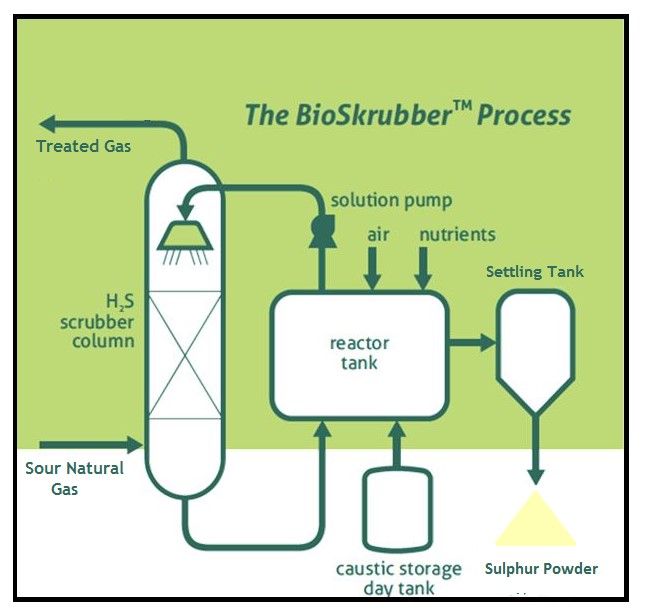
A simplified flow diagram of The BioSkrubberTM system is shown below

Biogas enters the bottom of a packed absorber column. H2S is removed from the Biogas in the absorber by the alkaline solution. The treated gas passes through a demister to minimize entrainment of solution and exits the absorber.

The H2S rich solvent from the bottom of the absorber is routed to the bioreactor. The bioreactor is sparged with air to enable the biocatalyst to convert the dissolved sulfide into elemental sulphur, thereby regenerating caustic soda. The regenerated solvent is recycled from the bioreactor back to the absorber. A small slipstream of solvent is typically bled from the system to prevent any build-up of salts.

The BioSkrubberTM system consists of three integrated process sections: an absorber, an aerobic biological reactor, and sulphur handling system.

Absorber

In the absorber, the Biogas is contacted counter-currently with the solvent, which is sprayed downwards through the column by nozzles. From the absorber bottoms, the H2S rich solvent is routed to the aerobic bioreactor, where the dissolved sulphides are oxidized into elemental S. It is important to note that the elemental S is produced in the bioreactor and not in the absorber. Because of this feature, plugging problems that frequently occur in conventional caustic or liquid iron-based scrubbing systems are minimized in the BioSkrubberTM system. The biologically produced elemental S actually increases the operational reliability of the system and enhances the H2S absorption.

Bioreactor

The aerobic bioreactor contains Thiobacillus microorganisms that oxidize the dissolved sulfides into elemental S. Appropriate bioreactor internals are used to ensure complete mixing. The volume of the bioreactor is designed to achieve optimal activity of the biocatalyst. The exhaust air from the reactor can normally be emitted to the atmosphere without further treatment.

The air supply to the bioreactor must be controlled to minimize the formation of sulfate and is automated by a control system.

The conversion of H2S into elemental S is a biological process, and the biocatalysts periodically require nutrients to maintain good performance. The nutrients include certain salts for their growth and maintenance. Extensive laboratory and field research has led to the optimization of the nutrient solution and dosing rate for this process. The nutrient solution is called Sulfix.

Sulfur Recovery

The produced elemental S is separated from the solvent in a settler. A portion of the bioreactor contents is recycled over the settler to maintain the desired dry solid content in the system. The elemental S slurry is then further processed in a decanter-centrifuge to obtain an S concentration of ~80-85 wt%. The elemental sulphur typically has a purity of ~95-98% on dry basis. The recovered water is recycled back to the process via the bioreactor.

IETL shall supply processed sulphur to farmers as fertilizer. IETL is selling ‘SulfabactR’ fertilizer to farmer for last five years.

IETL have done extensive research with Mahatma Phule Krushi Vidyapeeth on SulfabactR for its use as a fertilizer for certain crops such as sugarcane, onion, garlic, oilseeds (groundnut, soybean).